
How Much Does It Cost to Paint a House in Gainesville, FL?
What drives the price of an exterior repaint on a stucco or block home in North Florida, what prep should be included, and how to compare quotes.
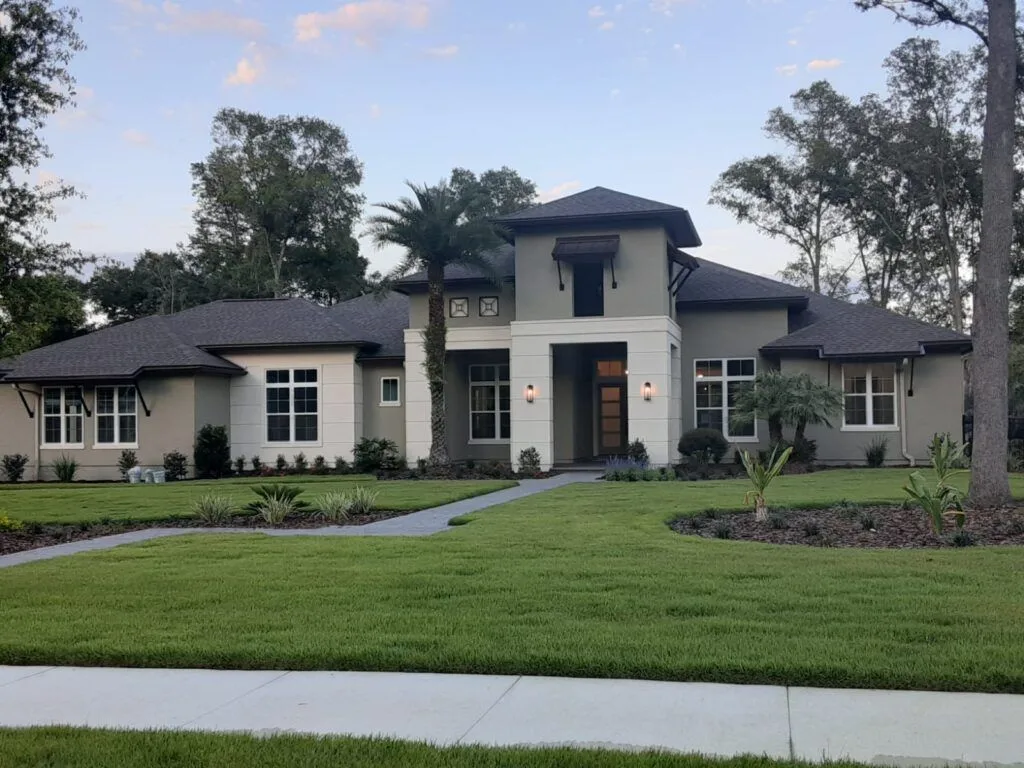
If you have started calling around for house painting quotes in Gainesville, you have probably noticed the numbers are all over the place. Two painters look at the same house and come back thousands of dollars apart. That is not always a sign someone is ripping you off. Usually it means the two quotes are for two different jobs. This guide explains what actually drives the cost of exterior house painting in Gainesville and Alachua County so you can compare quotes on equal footing.
Typical exterior painting cost ranges in Gainesville
For a single-story stucco or block home in Gainesville, most full exterior repaints from a licensed and insured painter fall somewhere between the mid four figures and the low five figures. Two-story homes, homes with a lot of wood trim, and homes that need real repair work before paint land higher. A small ranch home with sound stucco and minimal trim is at the low end. A two-story home with rotted fascia, cracked stucco, and a dark-to-light color change is at the high end.
We do not publish a fixed price per square foot because it would be wrong for most houses. The honest answer is that we come out, measure, look at every surface, and write a quote with the repairs and products listed. It is free and it takes about 30 minutes.
What drives the price
1. Square footage of wall, not floor
Painters price the surface they paint. A 2,000 square foot two-story house has far more wall than a 2,000 square foot ranch because the same floor area is stacked. Ceiling height, gables, and dormers all add wall.
2. Condition of the surface
This is the biggest variable in Gainesville. Chalky stucco needs a bonding primer. Cracked stucco needs elastomeric patching. Rotted fascia and soffit boards need to be replaced before they are painted. Failed caulk around every window and door needs to be cut out and redone. Mildew on the north side needs to be washed off with a solution, not just water. A quote that includes all of that will be higher than a quote that skips it, and the paint job will last two or three times longer.
3. Color change
Going from a dark color to a light one, or from light to a deep red or navy, usually needs a tinted primer or a third coat to get full coverage. Staying close to the existing color is cheaper.
4. Trim and detail
Fascia, soffits, shutters, columns, railings, window trim, and doors are all painted by hand with a brush. A house with a lot of trim takes more hours than a plain stucco box of the same size.
5. Paint quality
A 100 percent acrylic exterior paint rated for UV and moisture costs more per gallon than builder-grade paint, and it is the difference between a repaint in seven to ten years and one in four. We list the exact product on every quote so you know what you are paying for.
6. Access
Steep lots, pool cages, dense landscaping, and three-story sections that need a lift add time and equipment.
What should be included in every quote
- Pressure washing every surface before paint
- Crack repair and patching on stucco
- Cutting out and replacing failed caulk at windows and doors
- Replacing or repairing rotted wood, priced separately if extensive
- Spot priming bare and patched areas, full priming on chalky or previously failed surfaces
- Two full coats of a named exterior paint
- Protection of landscaping, windows, roof, and driveway
- Daily cleanup and a final walkthrough with you
If a quote does not spell these out, ask. A low number that skips washing and priming is not a bargain.
How to compare quotes
Put the quotes side by side and check five things: the paint product named, the number of coats, whether washing and priming are listed, how repairs are handled, and whether the painter is licensed and insured with a written guarantee. If two quotes match on all five, the cheaper one is the better deal. If they do not match, the cheaper one is usually cheaper because something was left out.
When is the best time to paint in Gainesville?
We paint year-round. Fall and spring are the easiest weather. Summer works with early starts and planning around afternoon storms. Winter is fine except on the handful of nights that drop below the temperature the coating needs to cure. The best time to paint is before the old paint fails, because once water is behind the finish, the repair bill goes up fast.
Get a real number for your house
The only way to know what your house will cost is to have someone look at it. HVR Painting is a family-owned, licensed and insured painting company in northwest Gainesville. We come out for free, walk every side of the house with you, and leave you with a written quote. Call or text (352) 328-3659 or request an estimate online. Mention this website for 10 percent off qualifying jobs over $2,500.